
What Is a Martingale Collar? How It Works
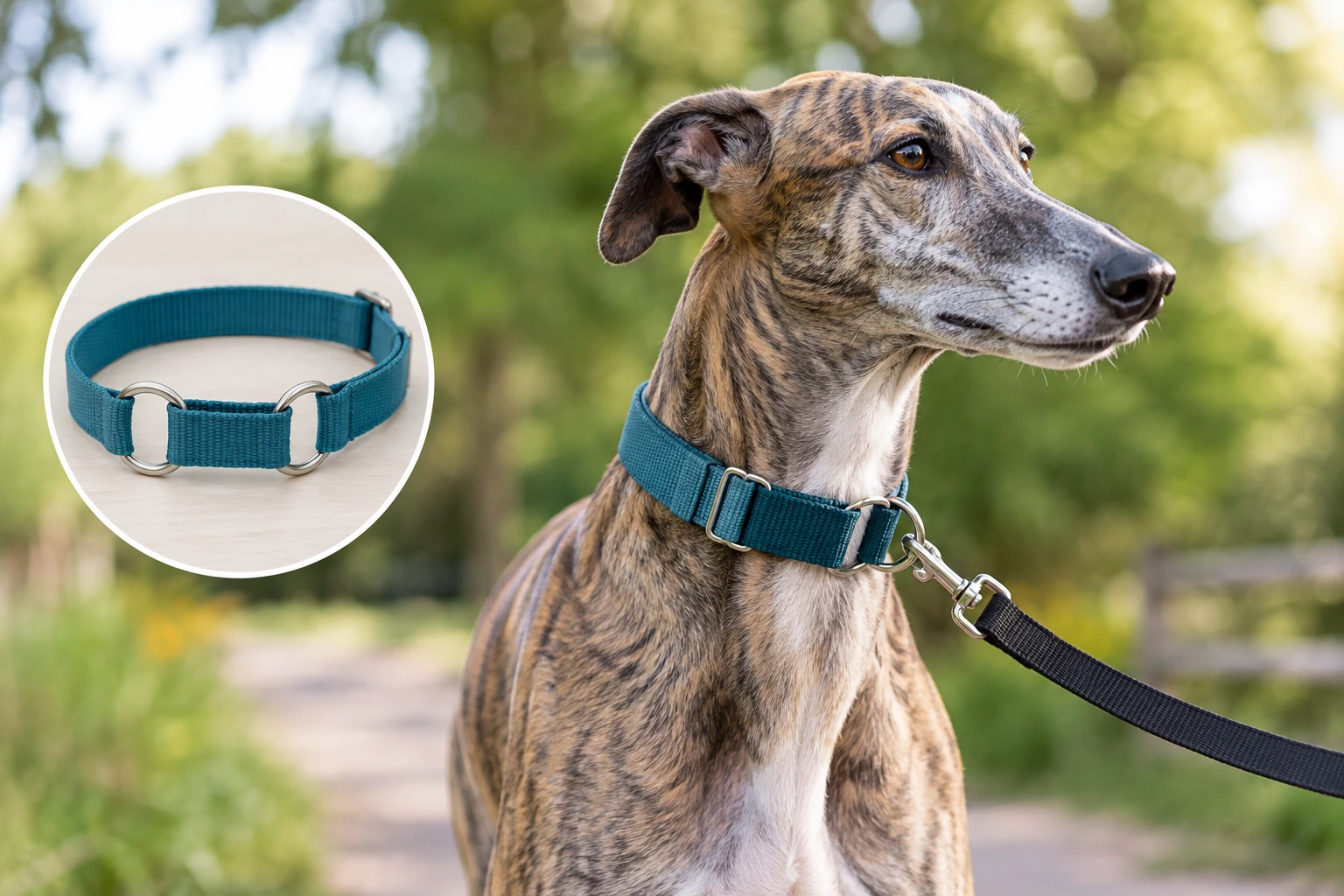
A martingale collar is a two-loop dog collar that tightens a limited amount when your dog pulls, then loosens again the moment the tension stops. It was designed to solve one specific problem: dogs whose heads are narrower than their necks can back straight out of an ordinary flat collar. Sighthounds are the classic case, but any dog that has ever slipped a collar is a candidate.
How Does the Two-Loop Mechanism Works?

A large loop sits around the dog’s neck like a normal collar. A smaller control loop connects the two ends of that large loop, and the leash clips onto the small loop rather than directly to the collar.
When your dog pulls, leash tension pulls the small loop closed. That closing action draws the large loop snug around the neck. When you stop pulling, the small loop opens again and the collar returns to its resting size.
Why It Can’t Choke Your Dog?
This is the part people get wrong most often. The tightening isn’t unlimited.
The length of the small control loop sets a hard stop. Once the two rings on the small loop meet, the collar physically cannot tighten any further, no matter how hard the dog pulls. A choke chain has no such limit, which is the entire difference between the two designs.
That’s why martingales are sometimes called limited-slip collars and why trainers who avoid choke chains still recommend them.
Which Dogs Actually Need One?
The common factor is head shape, not breed name.
Sighthounds. Greyhounds, Whippets, Salukis, and Italian Greyhounds have long, narrow heads on thick, muscular necks. A flat collar sized to their neck slides right off over the head.
Narrow or tapered-head breeds. Some terriers, Shepherds, and mixes share the same proportions to a lesser degree.
Nervous or flight-risk dogs. Rescue and shelter dogs in a new home are far more likely to attempt to back out when startled, which is why many shelters send dogs home in a martingale.
Dogs learning leash manners. The gentle tightening acts as a mild, consistent cue that a flat collar doesn’t provide.
How to Fit a Martingale Correctly?
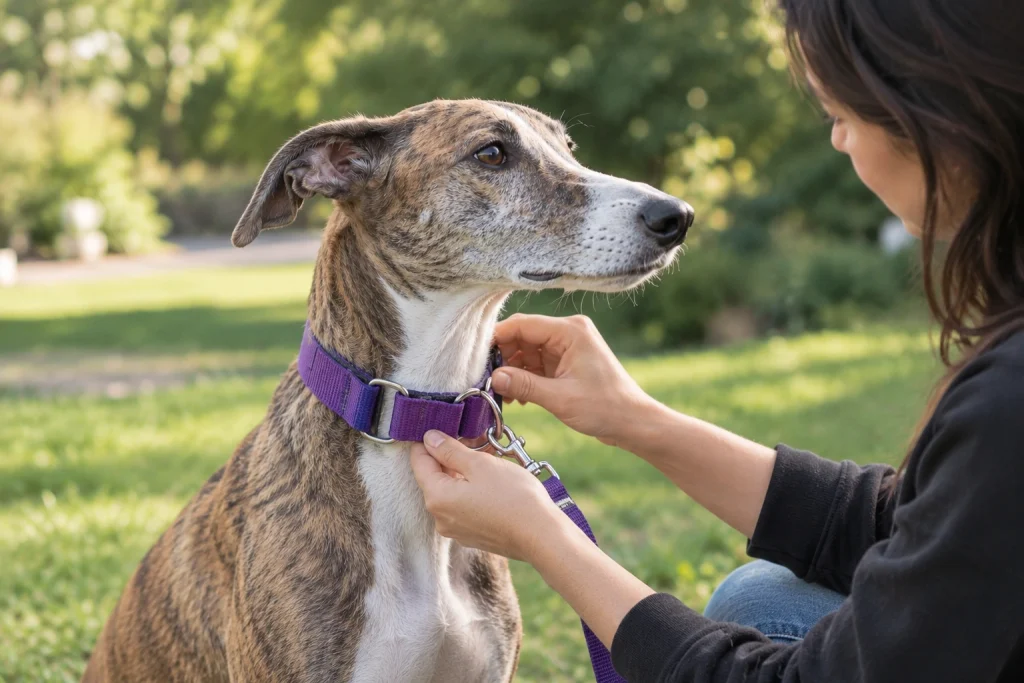
The fit rule is different from a flat collar because you’re checking it at the tightened point rather than the resting point.
Measure around the widest part of the skull, not just the neck, and confirm the collar cannot slide over the head when fully cinched. Then apply the standard two-finger check at that tightened position: two fingers should fit between the collar and the neck.
A martingale sized too loose defeats the entire design, since the dog can still back out before the stop point is reached. Our dog collar sizing guide covers the measuring technique in more detail.
Martingale vs Choke Chain vs Flat Collar
Flat collar: Fixed size, no tightening at all. Fine for calm dogs and everyday ID tags, but escapable for narrow-headed breeds.
Martingale: Tightens to a preset limit, then stops. Prevents escape without ever restricting the airway.
Choke chain: Tightens without any limit, which is what makes it capable of causing injury and why most modern trainers have moved away from it
Why You Shouldn’t Leave It On Unsupervised?
Because a martingale relies on controlled tension, most brands label it for supervised use only. The dangling control loop can catch on crate bars, fences, or furniture, which is a genuine snagging risk when nobody is watching.
The common setup among experienced owners is a martingale for walks and training, plus a standard flat collar worn full-time for ID tags. Our best collars for small dogs and best dog collar for large dogs guides cover everyday options, and our best martingale dog collar guide covers picks if you’ve decided a martingale is right for your dog.
Conclusion
A martingale collar solves escape without the injury risk of a choke chain, and the whole thing hinges on the small control loop that sets a hard tightening limit. Get the fit right at the cinched position rather than the resting one, use it for walks rather than around the clock, and it does exactly what it was designed to do.
Frequently Asked Questions
Q: Is a martingale collar the same as a choke chain?
A: No. A choke chain tightens without any limit, while a martingale stops tightening once the control loop closes, which means it cannot restrict the airway no matter how hard the dog pulls.
Q: How tight should a martingale collar be?
A: Check it at the fully tightened position, not at rest. Two fingers should fit between the collar and the neck, and it should not be able to slide over the head at that point.
Q: Can any breed wear a martingale collar?
A: Yes, though the dogs that benefit most are those with heads narrower than their necks. For other breeds, a flat collar usually works fine unless the dog has a history of slipping out.
Q: How long can my dog wear a martingale collar?
A: Most brands recommend supervised use only, so typically just during walks and training sessions rather than continuously, because the dangling control loop can snag on crates or fences.
Q: How long does it take a dog to adjust to a martingale collar?
A: Most dogs accept it within a few days to about two weeks of short, positive sessions, since the sensation is much milder than a choke chain or prong collar.
Q: Should I use a martingale or a harness for a dog that pulls?
A: A martingale prevents escape but does little to reduce pulling itself. For a dog that pulls hard, a front-clip harness redirects the momentum more effectively, and many owners use both for different situations.




5 Comments