What Is a Prong Collar? How to Fit and Use One Safely
A prong collar, also called a pinch collar, is a training collar made of interlocking metal links with blunt prongs facing inward toward the dog’s neck. When leash tension is applied, the links draw together, and the prongs apply even pressure around the neck rather than concentrating it on the throat.
It’s one of the most divisive tools in dog training. Critics call it cruel. Trainers call it clearer communication than a flat collar. The honest answer is that almost every genuine prong collar horror story traces back to a fitting error, which is where this guide focuses. For how it compares to other correction collars, see our types of dog collars guide.
How a Prong Collar Actually Works
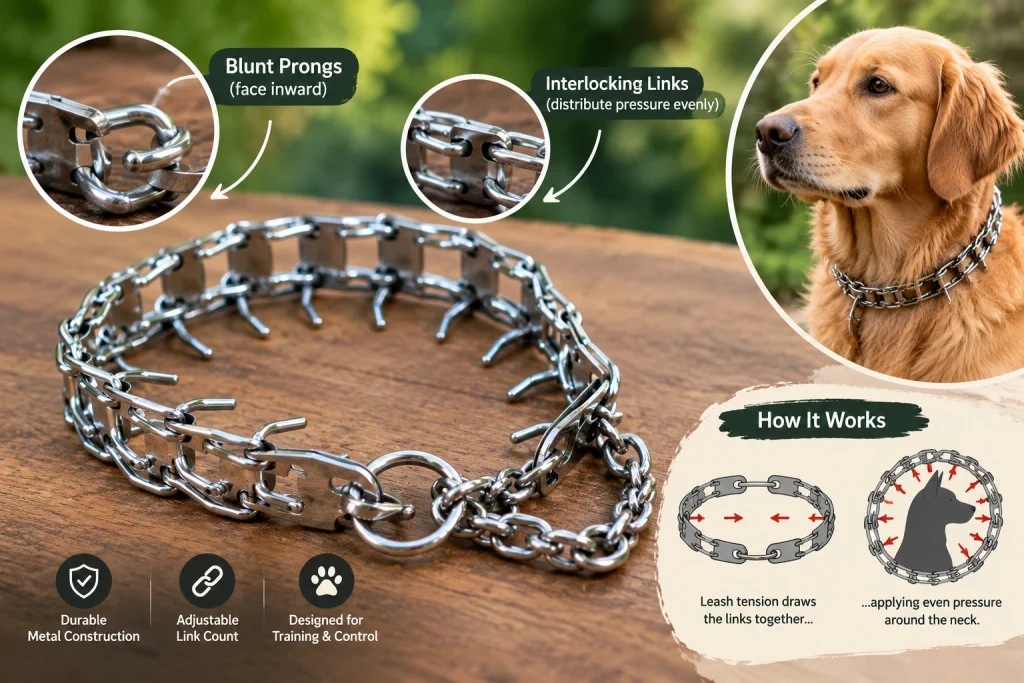
A flat collar concentrates all pulling force on a narrow band across the front of the neck, directly over the trachea. That’s why a dog pulling hard on a flat collar coughs and gags.
A prong collar distributes that same pressure evenly around the entire neck. The prongs are blunt, not sharp, and they don’t puncture skin. Trainers commonly describe the sensation as closer to a tap on the shoulder than a jab.
The design intent is tactile communication, mimicking the way a mother dog uses gentle mouth pressure to correct a puppy, rather than pain-based punishment.
Sizing: Gauge and Link Count
Two sizing decisions matter, and they’re independent of each other.
Wire gauge. Most dogs use a 2.5 mm prong collar. Larger, stronger breeds like German Shepherds, Pit Bulls, and Dobermans typically need 3 mm. Counterintuitively, a thicker gauge is generally gentler, since it spreads pressure over more surface area.
Link count. This determines the actual circumference. Links are added or removed to reach a snug fit, which is why prong collars ship long and get customized to the individual dog. Our dog collar sizing guide covers general measuring techniques if you’re unsure of your dog’s baseline neck size first.
Prong collars are generally not recommended for small dogs.
The Fit Rule That Everyone Gets Wrong

This is the single most important part of prong collar use and where most misuse happens.
The collar must sit high on the neck, right behind the ears and up under the jawline, not hanging loose at the base of the neck like a flat collar.
A loose prong collar is more dangerous than a snug one. When it hangs low, slack builds up, and any correction delivers force into that slack before reaching the dog. That creates a jerking motion into a less sensitive area, which is exactly what causes injury.
A properly snug collar sits in a highly sensitive area where very little force is needed. Less pressure, a clearer signal, and a safer outcome.
The most common beginner mistake: not removing enough links. If the collar sags, take more links out.
How Corrections Should Be Delivered
A correction is a quick leash pop, then immediate release. It’s not a sustained pull, and it’s not a lift.
A brief, well-timed pop is both more effective and less harmful than dragging the dog back with constant tension. Most trainers pair prong work with a shorter 4-foot training leash rather than a long lead, since it makes precise timing easier.
When Not to Use a Prong Collar
The trainers who use prong collars professionally are the same ones with the longest list of exclusions.
Not on aggressive dogs. Adding an aversive to aggression frequently escalates it.
Not on nervous, fearful, or panicking dogs. Same reason.
Not as punishment. It’s meant as a communication signal, not a consequence.
Not as a replacement for training. It manages leash behavior; it doesn’t teach anything by itself.
Not left on unsupervised. Never for tie-outs, crates, or all-day wear. It goes on for the session and comes off after.
Not for small dogs or as a first tool before gentler options have been tried.
Safer Alternatives Worth Trying First

Most owners reaching for a prong collar are trying to solve pulling. Two options generally come first.
A front-clip no-pull harness redirects a pulling dog sideways without any neck pressure at all. Our best no-pull dog harness guide covers those.
A martingale collar prevents escape with limited, gentle tightening and no prongs. Our What Is a Martingale Collar Guide explains how it works.
If those haven’t worked and you’re considering a prong, working with an experienced trainer for the initial fitting is worth more than any article, including this one.
Conclusion
A prong collar distributes pressure more evenly than a flat collar, and at a correct fit it needs very little force to communicate. But the tool is unusually unforgiving of user error: a collar hanging loose at the base of the neck is genuinely more likely to injure a dog than one fitted snugly behind the ears. Fit first, gentler tools first, and a professional first if you’re unsure.
Frequently Asked Questions
Q: Are prong collars cruel?
A: Not inherently, but they’re easy to misuse. Injury almost always comes from poor fit, sustained pulling, or use on fearful or aggressive dogs.
Q: Where should a prong collar sit on the neck?
A: High on the neck, right behind the ears and under the jawline. A collar hanging low creates slack and makes corrections more forceful.
Q: What size prong collar does my dog need?
A: Most dogs use a 2.5 mm gauge. Large, powerful breeds usually need 3 mm. Remove links until the fit is snug with no sag.
Q: Do prong collar prongs hurt or pierce the skin?
A: No. The prongs are blunt and don’t puncture. Correctly fitted, the sensation is closer to a tap than a jab.
Q: Can I leave a prong collar on my dog?
A: No. Prong collars go on for training or walks and come off afterward. Never use one for tie-outs or unsupervised wear.