
5 Best Harnesses for Large Dogs (2026)
Finding the best harness for large dogs comes down to hardware and weight distribution more than looks. A big, strong dog can put real force on a leash attachment point, so a harness needs reinforced stitching, wide padded straps, and a design that spreads pressure across the chest and shoulders instead of the neck.
Below are five harnesses built to handle that kind of size and strength, followed by a full buying guide covering fit, materials, and control features.
Quick Comparison
Product |
Best For |
Weight Capacity | Leash Attachment |
Amazon |
|---|---|---|---|---|
Kurgo Tru-Fit Smart Harness |
Overall pick |
Up to 75 lbs. |
Front and back clips |
View on Amazon |
| Julius-K9 IDC Power harness | Strength and durability |
Load-rated to 300 kg |
Back clip, side rings optionamazon.com/dp/B003WLFDJCal |
View on Amazon |
Ruff wear Front Range Dog Harness |
Active and hiking dogs |
Large/X-Large fit |
Front and back clips |
View on Amazon |
| Rabbit Power Harness goo Escape Proof Dog Harness | Escape-prone dogs |
Large sizing | Back clip with lift handle |
View on Amazon |
Amazon Basics No-Pull Dog Harness |
Budget pick |
Large sizing |
Front chest clip |
View on Amazon |
Best Harness for Large Dogs
1. Kurgo Tru-Fit Smart Harness – (Best Harness for Overall)
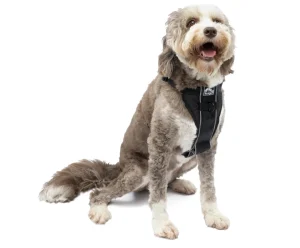

This harness uses five points of adjustment to create a genuinely custom fit across a large dog’s chest and shoulders, which matters more on bigger breeds where body shapes vary widely. It gives you both a front D-ring for no-pull training and a back D-ring for relaxed walking, plus a padded chest plate and a built-in seat belt loop for car rides. Quick-release buckles make it fast to put on and take off, even on a dog that would rather be doing anything else.
| Pros | Cons |
|---|---|
| • Five adjustment points create a precise fit across different large-breed body shapes | • Padding is moderate rather than heavy-duty, so extremely strong pullers may want a reinforced option |
| • Front and back leash attachments cover both training and everyday walking | • Five straps take slightly longer to adjust the first time than a simple vest harness |
| • Built-in seatbelt loop doubles as a car safety tether | • Not crash-tested, so it should not replace a dedicated car safety harness |
Best for: large dog owners who want one harness that handles daily walks, light training, and car rides
2. Julius-K9 IDC Powerharness – (Best Heavy-Duty Harness for Large Dogs)
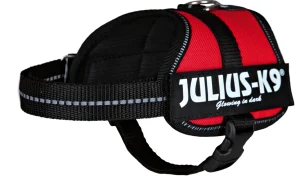
Built in Germany from reinforced webbing, this harness is rated to hold up to 300 kilograms of force before the buckle releases, which puts it well beyond what any dog could generate through pulling alone. It distributes pressure evenly across the chest and shoulders rather than concentrating it at one clip point, which reduces strain on a large dog’s joints during a hard pull. Reflective piping along the chest strap adds visibility for early morning or nighttime walks.
| Pros | Cons |
|---|---|
| • Exceptionally durable construction built to withstand years of daily, heavy use | • Priced well above most large dog harnesses on this list |
| • Even weight distribution reduces joint strain compared to single-point harnesses | • Primary leash attachment is on the back, so it relies on a snug fit rather than a front clip for pull control |
| • Reflective edging functions as a real visibility aid on low-light walks | • Sizing runs specific to the brand’s own chart, so measuring correctly matters more than usual |
than usual
Best for: owners of powerful, working-style breeds who want a long-term, heavy-duty investment.
3. Ruffwear Front Range Dog Harness – (Best Harness for Large Dogs That Hike and Run)
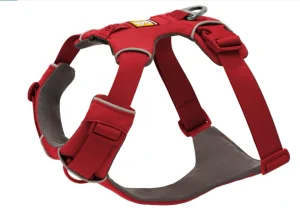
Built with foam-padded webbing and four points of adjustment, this harness holds its shape through repeated wear better than most soft mesh options, which matters for large dogs that spend real time outdoors. It gives you two leash attachment points, an aluminum V-ring on the back for everyday walks and a reinforced webbing loop at the chest for light pull correction, along with a small ID pocket built into the back panel.
| Pros | Cons |
|---|---|
| • Four adjustment points create a locked-in fit that holds up on long hikes | • Runs pricier than basic vest-style harnesses |
| • Foam padding keeps its shape better over time than basic mesh harnesses | • Bulkier profile than minimalist designs, which can trap heat on warm days |
| • Two leash attachment points cover both relaxed walking and training. | • The V-ring’s back-clip position gives less pull correction than a true front-clip design. |
Best for: large, active dogs who hike, run, or spend long days outdoors with their owner.
4. Rabbit Goo Escape Proof Dog Harness – (Best Escape-Proof Harness for Large Dogs)
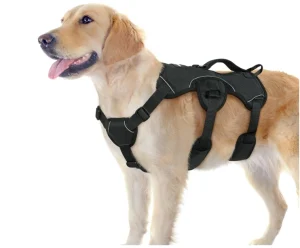
This harness adds three straps across the chest and belly specifically to prevent a large dog from backing out or wriggling free, which is a common escape method for strong, motivated breeds. A padded top handle gives you a firm grip to help a dog over obstacles, in and out of cars, or through crowded spaces, and five adjustment points let you dial in a snug fit rather than relying on a single strap.
| Pros | Cons |
|---|---|
| • Extra chest and belly straps meaningfully reduce the risk of a large dog escaping | • More straps mean a longer process to put on than a simple slip-over harness. |
| • Padded lift handle gives fast, secure control in tight or busy spaces | • Bulkier coverage than minimalist harnesses, which some short-haired dogs may find warm |
| • Five adjustment points allow a more precise, escape-resistant fit. | • The handle adds weight that isn’t necessary for calm, well-mannered dogs. |
Best for: large dogs with a history of slipping out of harnesses or owners who want extra physical control near traffic or crowds.
5. Amazon Basics No-Pull Dog Harness – (Best Budget Harness for Large Dogs)
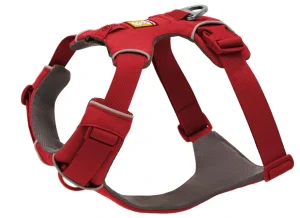
This is a straightforward option for owners who want the core no-pull mechanics without paying premium prices. It’s a soft padded vest with a front-clip attachment, adjustable straps, and reflective stripes for basic visibility, all at one of the lowest price points among true no-pull harnesses sized for large dogs.
| Pros | Cons |
|---|---|
| • Genuinely affordable compared to name-brand large dog harnesses | • Build quality is not rated for years of heavy daily wear the way premium harnesses are |
| • Reflective stripes add visibility that some pricier competitors skip | • Fewer adjustment points than dual-clip or five-point options, so the fit is less precise on oddly shaped dogs |
| • Soft padded vest is comfortable for daily walks. | • Sizing runs across standard large ranges rather than breed-specific cuts |
Best for: owners who want a functional no-pull harness for a large but well-mannered dog without a big investment.
Buying Guide: How to Choose the Best Harness for a Large Dog
Sizing by Chest Girth, Not Weight
Large dog harnesses should be sized off chest girth, not weight or breed alone, since two dogs of the same weight can have very different builds. A barrel-chested Labrador and a leaner Boxer of the same weight often need different sizes entirely. Measure around the widest part of your dog’s chest, just behind the front legs, using a soft tape measure, and compare that number against the specific brand’s size chart rather than relying on a general “large” label.
Hardware and Strap Width
Strong dogs put real, repeated force on buckles and D-rings, so cheap plastic hardware and thin straps are a weak point. Look for metal D-rings rather than plastic ones and wider straps, generally 1 to 1.5 inches, which distribute pressure over more surface area instead of concentrating it in a thin line across the shoulders.
Front Clip vs. Back Clip vs. Dual Clip
A front-clip harness redirects a dog sideways the instant they pull forward, which makes pulling less effective and, over time, less rewarding. A back-clip harness is more comfortable for casual walking but gives a strong dog full leverage to pull. A dual-clip design gives you both in one harness, which is useful if you’re actively training a puller but also want a relaxed setup once the behavior improves. For a deeper look at front-clip mechanics specifically, see our best no-pull dog harness guide.
Load Rating and Durability
For genuinely powerful breeds, reinforced stitching at the leash attachment points matters more than any other single feature, since that’s where stress concentrates during a hard pull. Nylon and polyester webbing hold up well across seasons, while cheaper fabrics can stretch or fray within months of regular large-dog use.
Comfort and Padding
Padded straps, especially around the chest and under the front legs, prevent chafing on dogs that wear a harness for long walks or hikes. Breathable mesh liners matter more on large harnesses than small ones, since a bigger panel traps more heat. A collar vs. harness approach also matters here: A harness spreads pressure across the chest instead of the neck, which is safer for large dogs that pull. For a closer comparison, see our dog harness vs. collar guide.
Fit and Escape Prevention
The fit should be snug enough that you can slide two fingers flat under any strap but loose enough that your dog can move naturally without rubbing at the armpits. Large, strong dogs that lunge hard are more likely to test a loose fit, so multiple adjustment points and secure buckles matter more here than on calmer breeds.
Price
Basic no-pull harnesses for large dogs typically run $12 to $22. Mid-range options with padding, dual clips, and reflective trim generally fall between $22 and $40. Premium, heavy-duty harnesses with reinforced materials and load-rated hardware, like the Julius-K9 above, run closer to $50 to $80. If your dog is on the smaller end of the spectrum instead, our best small dog harness guide covers size-specific picks, and if your dog also needs a properly sized collar for ID tags, our best collars for large dogs guide has matching options.
Conclusion
For most large dog owners, the Burgoo Tu-Fit Smart Harness offers the best mix of fit, control, and everyday practicality. Owners of especially powerful or working-style breeds should look at the Julius-K9 IDC Power harness for long-term durability, while active dogs that hike or run do well in the Ruff wear Front Range. Dogs with a history of slipping out of gear are safer in the Rabbit Goo Escape Proof Harness, and anyone shopping on a budget can start with the Amazon Basics No-Pull Dog Harness.
Frequently Asked Questions
Q: What size harness does a large dog need?
A: It depends on chest girth rather than weight alone, since two dogs of the same weight can have very different builds. Measure around the widest part of the chest, just behind the front legs, and compare that number to the specific brand’s size chart.
Q: Is a harness better than a collar for a large dog?
A: Generally, yes, for daily walks. A harness spreads pressure across the chest and shoulders instead of the neck, which reduces the risk of choking or trachea strain, especially on large dogs that pull hard on leash.
Q: Front clip or back clip, which is better for large dogs that pull?
A: A front-clip harness is more effective for active pulling, since it steers the dog off-balance when they lunge forward. A back-clip harness is more comfortable for dogs who already walk well but does less to interrupt a strong puller.
Q: How do I stop my large dog from escaping its harness?
A: Make sure the fit is snug enough that you can only slide two fingers under any strap and choose a harness with multiple adjustment points and secure metal hardware. Escape-proof designs with extra chest and belly straps add another layer of security for determined dogs.
Q: How much weight can a large dog harness hold?
A: It varies by brand and construction. Basic harnesses are built for everyday walking rather than a rated load, while heavy-duty options like the Julius-K9 are tested to hold several hundred kilograms of force before the hardware releases.
Q: How often should I replace my large dog’s harness?
A: Check the stitching, buckles, and D-rings every few months, and replace it sooner if any hardware shows signs of wear or if your dog is still growing into

6 Comments